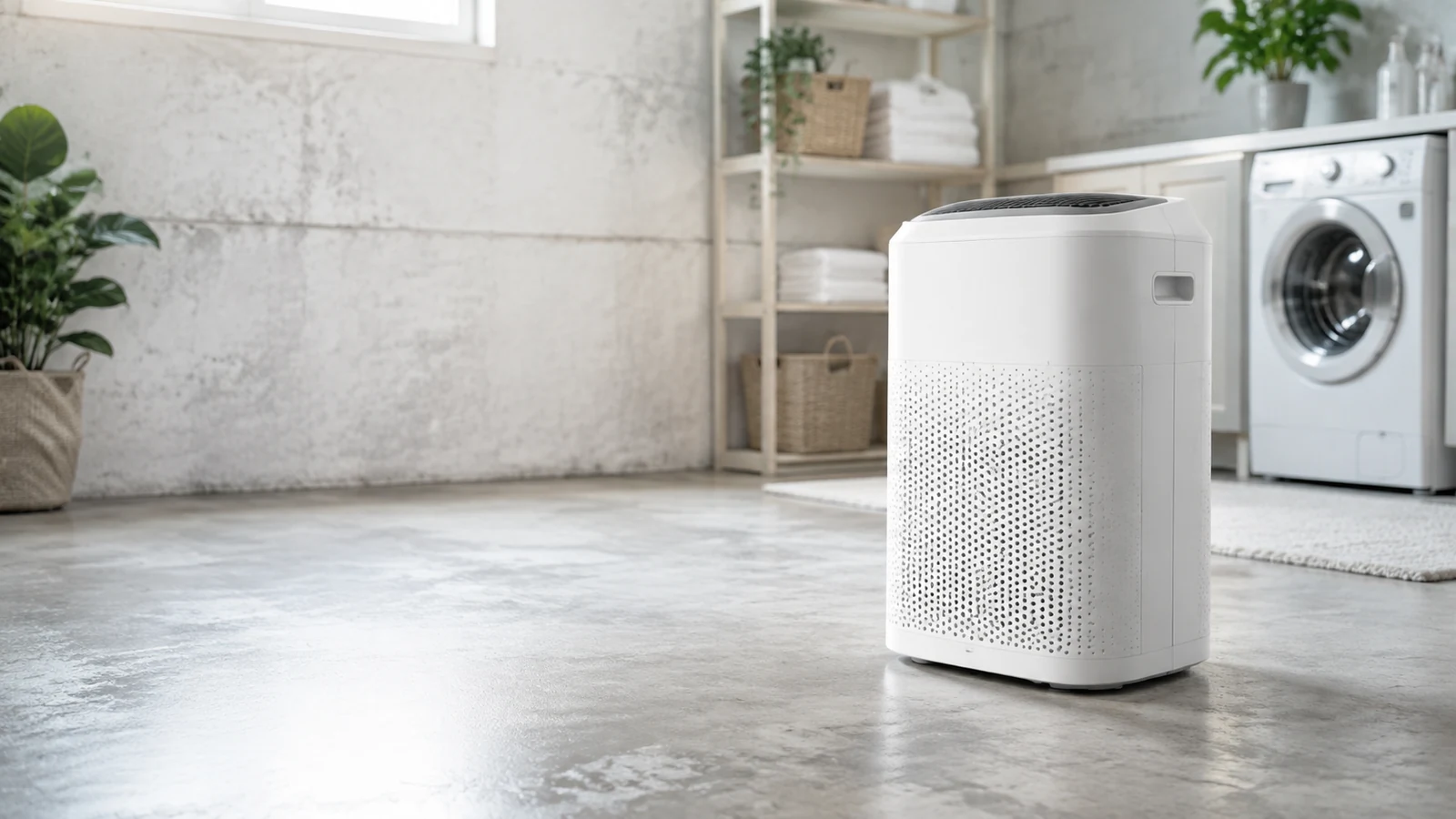
A musty basement or water drops on your pipes can mean too much moisture. The EPA says the key to mold control is moisture control. We compared 50-pint models on the makers' published capacity, drain type and coverage. We do not test products ourselves.
Last updated: October 2026 · By the CleanAirHomeLab team
Quick Picks
Short on time? Here are our picks by use case. Scroll down for the full specs and drain options.
What Size Dehumidifier Do You Need?
Capacity is rated in pints of water removed per day. ENERGY STAR says the Department of Energy changed the test in 2019. Units are now tested at 65 F instead of 80 F, so newer ratings are lower. ENERGY STAR's rough guide: a unit rated 70 pints under the old test is about 40 to 45 pints under the new one, and an old 50-pint is about 30. This chart from ENERGY STAR uses the new ratings:
How damp is the space?
Under 2,000 sq ft
Over 2,000 sq ft
Slightly to moderately damp: feels damp, musty smell at times (50 to 75% relative humidity)
20 to 30 pints/day
30 or more pints/day
Very damp: always feels and smells damp, damp spots on walls and floors (75 to 90% relative humidity)
25 to 40 pints/day
40 or more pints/day
Wet: walls or floor sweat, or water seeps in (90 to 100% relative humidity)
30 to 50 pints/day
50 or more pints/day
ENERGY STAR says it is better to oversize than undersize. Every pick on this page is a 50-pint unit.
Pump vs. Gravity Drain: Which Do You Need?
This is the biggest choice when you buy a dehumidifier. Get it wrong and you will be emptying the bucket by hand.
Gravity Drain
Water flows downhill through a hose to a floor drain or sink. It works when the drain sits below the unit.
No pump to wear out
Just a hose to the drain
Drain must be below the unit
Cannot push water uphill
Built-in Pump
A pump inside the unit pushes water up. Frigidaire says the FHDP5033W1 sends water up to a sink or out a window.
Drain can be above the unit
No floor drain needed
One more moving part
Our take: If a floor drain sits right below where the unit will go, a gravity model is all you need. If not, get the pump built in.
What We Look For
Drain Setup
Pump or gravity? Can the hose reach your drain? This makes or breaks daily use.
Noise
If the maker lists a noise range, look at the high number too, not just the low one.
Running Cost
A dehumidifier can run for months. ENERGY STAR says a certified unit uses 20% less energy than a similar regular one.
Still in Production
We check the maker's own page. Two models that used to top this list are no longer made, and we say so below.
Full Reviews
#1 Best With A Pump
Frigidaire FHDP5033W1
Check current price
Current 50-pint Frigidaire with a built-in pump. It sends water up into a sink or out of a window, so the drain does not have to sit below the unit.
Key Specs
Capacity
50 pints/day
Drain
Built-in pump, discharges upward to a sink or window
Low-temperature operation
Rated down to 41 F
Smart control
Frigidaire app, Amazon Alexa, Google Home
Production status
Current
What We Like
Built-in pump, so the drain can be above the unit
Rated to run down to 41 F
Frigidaire app plus Alexa and Google Home
Currently in production, unlike the FFAD5033W1
What Could Be Better
We could not read a coverage figure or Energy Star status on Frigidaire's page, so we publish neither
We have no verified Amazon ASIN for this model yet, so its link is a search
Our Verdict
The FHDP5033W1 is a current 50-pint model with a built-in pump. The pump sends water up to a sink or out of a window. If your drain sits below the unit, you do not need a pump. We could not read a coverage figure or Energy Star status on Frigidaire's page, so we quote neither.
Current 50-pint Frigidaire with Wi-Fi and Energy Star certification. Gravity drain, no pump.
Key Specs
Capacity
50 pints/day
Drain
Gravity hose, no pump
Smart control
Frigidaire app, Wi-Fi
Energy Star
Yes
Production status
Current
What We Like
Currently in production
Wi-Fi with the Frigidaire app
Energy Star certified
What Could Be Better
No pump, so a continuous drain has to run downhill
We could not read a coverage figure or a decibel rating on Frigidaire's page, so we publish neither
Our Verdict
The FHDD5033W1 is a current 50-pint model with Wi-Fi and Energy Star certification. It replaces the Frigidaire FFAD5033W1. It drains by gravity and has no pump. Choose it over the pump model only if your drain sits below the unit.
50-pint cube dehumidifier. Midea rates it for up to 4,500 sq ft. It has no built-in pump. It drains through the included hose.
Key Specs
Capacity
50 pints/day
Coverage
Up to 4,500 sq ft
Drain
Continuous gravity drain via included hose (no built-in pump)
Dimensions
14.45 W x 14.76 H x 14.57 D inches
Weight
41.5 lbs
Warranty
1 year
What We Like
50 pints a day, rated for up to 4,500 sq ft
Continuous drain through the included hose
Works with the Midea SmartHome app and voice assistants
What Could Be Better
No built-in pump, so the drain must sit below the unit
1-year warranty
Our Verdict
The Midea MAD50S1QWT is a 50-pint cube dehumidifier. Midea rates it for up to 4,500 sq ft. It has no built-in pump. It drains by gravity through the included hose, so the drain must sit below the unit. If your drain is higher than the unit, look at a pump model.
DISCONTINUED. LG's own product page marks this model discontinued, and the UD501KOJ5 that replaced it is discontinued too. Listed here for owners who already have one.
Key Specs
Production status
Discontinued
What We Like
Listed for owners who already have one
What Could Be Better
LG's product page marks this model discontinued
The UD501KOJ5 that replaced it is marked discontinued too
Our Verdict
LG marks the UD501KOG5 discontinued. The UD501KOJ5 that replaced it is marked discontinued too. It is listed for owners who already have one, not as a pick. We publish no specs for it because we hold no source for them.
#5
Frigidaire FFAD5033W1
Check current price
SUPERSEDED. Frigidaire has replaced this model with the FHDD5033W1 and FHDP5033W1. Listed here for owners who already have one.
Key Specs
Production status
Superseded by the FHDD5033W1 and FHDP5033W1
What We Like
Listed for owners who already have one
What Could Be Better
Replaced by the FHDD5033W1 and the FHDP5033W1
Our Verdict
Frigidaire has replaced the FFAD5033W1. The FHDD5033W1 is the current Wi-Fi model with a gravity drain. The FHDP5033W1 is the current model with a built-in pump. We publish no specs for the FFAD5033W1 because we hold no source for them.
#6
GE ADEL50LZ (DISCONTINUED)
Check current price
DISCONTINUED. GE states this model is no longer manufactured. Remaining stock is clearance. Listed here for owners who already have one.
Key Specs
Production status
Discontinued
What We Like
Listed for owners who already have one
What Could Be Better
GE states this model is no longer being manufactured
Remaining stock is clearance
Our Verdict
GE states the ADEL50LZ is no longer being manufactured. Remaining stock is clearance. It is listed for owners who already have one, not as a pick. We publish no specs for it because we hold no source for them.
Running Cost
We could not find a wattage on the makers' pages for these models, so we do not print a monthly or yearly cost. Your cost depends on how damp the space is and how long the compressor runs. ENERGY STAR says a certified dehumidifier removes the same amount of water as a similar regular unit but uses 20% less energy. Frigidaire lists the FHDD5033W1 as ENERGY STAR certified.
Noise Level Comparison
Noise matters if the dehumidifier runs in a room you use. In a basement you rarely visit, skip this section.
We removed the decibel chart that used to sit here. It ranked five units to the decibel, but three of those models are out of production and none of the figures could be traced to a manufacturer specification. Midea, Frigidaire and GE do not publish a decibel rating on the product pages we can read, so any chart we drew would be made up.
A model with a built-in pump also has the pump running from time to time. If quiet matters most to you, check the maker's spec sheet for the exact model before you buy.
Maintenance Tips
1
Clean the filter as the manual says
Each maker sets its own schedule. ENERGY STAR says to keep the unit away from dust sources like woodworking tools, because dust can clog the coils and grills.
2
Keep the drain hose short and clear
ENERGY STAR says to put the unit close enough to the drain that you do not need a long hose. Keep drain hoses away from electrical cords.
3
Give it room to breathe
ENERGY STAR says that if the air does not blow out the top, keep the unit away from walls and furniture so air can move around it. Close doors and windows while it runs.
4
Use a hygrometer if you need one
ENERGY STAR says certified units have a built-in humidistat. If yours does not show the humidity, a separate hygrometer near the unit lets you see it.
Common Questions
What size dehumidifier do I need for my basement?+
ENERGY STAR gives a chart. For a space under 2,000 square feet: 20 to 30 pints a day if it is slightly damp, 25 to 40 if very damp, and 30 to 50 if wet. For a space over 2,000 square feet: 30 or more, 40 or more, and 50 or more. ENERGY STAR also says it is better to oversize than undersize.
Do I need a dehumidifier with a pump?+
If you have a floor drain or sink below the unit, a hose can drain to it by gravity. ENERGY STAR says a hose can run to a floor drain or sump. If your drain is higher than the unit, or you want to send water out a window, you need a pump. The Frigidaire FHDP5033W1 has one built in. The Midea MAD50S1QWT does not.
How much does it cost to run a dehumidifier?+
We do not have a wattage from the makers of these models, so we do not guess a monthly cost. ENERGY STAR says a certified unit removes the same amount of water as a similar regular unit but uses 20% less energy. Look for the ENERGY STAR label.
What humidity level should I set my dehumidifier to?+
The EPA says to keep indoor humidity below 60 percent, ideally between 30 and 50 percent. ENERGY STAR also says 30% to 50%, and 30% to 40% in cold climates during the heating season to prevent window condensation.
Can I use a dehumidifier in a crawl space?+
Check the temperature first. ENERGY STAR says that if the space is often below 65 F, look for a model made for lower temperatures, because frost can form on the coils. Frigidaire rates the FHDP5033W1 down to 41 F. A pump or a hose to a drain saves you from emptying a bucket in a tight space.
How do I take care of a dehumidifier?+
Follow the maker's manual for cleaning the filter. ENERGY STAR says to keep the unit away from dust sources like woodworking tools, which can clog the coils. If the air does not blow out the top, keep the unit away from walls and furniture so air can move around it. Close doors and windows while it runs.
The Bottom Line
For most basements with a floor drain, the Midea MAD50S1QWT is our pick. Midea lists 50 pints a day and up to 4,500 sq ft. It has no built-in pump, so run the hose down to the drain. Set the humidity between 30 and 50 percent, as the EPA suggests.
If your drain is above the unit, get the Frigidaire FHDP5033W1, which has a built-in pump. If you want Wi-Fi and the ENERGY STAR label, look at the Frigidaire FHDD5033W1.
This page is general information, not medical advice.
Affiliate Disclosure: Some links on this page are Amazon affiliate links and may earn us a commission at no extra cost to you. As an Amazon Associate I earn from qualifying purchases. Midea and Frigidaire do not pay us. Our picks are based on the makers' published figures, not commission rates. Full disclosure.
Sources and last review
Specifications on this page are taken from the documents below, on the dates shown. We do not physically test products; read our methodology. Page last reviewed .
Two models that previously held top recommendation slots on this page are out of production: LG states the UD501KOG5 is discontinued, and GE states the ADEL50LZ is no longer manufactured. They remain listed above, labelled, for readers who already own one. Midea's page lists 4,500 sq ft in its spec table but 1,500 sq ft in one line of its marketing text; we quote the spec table.